
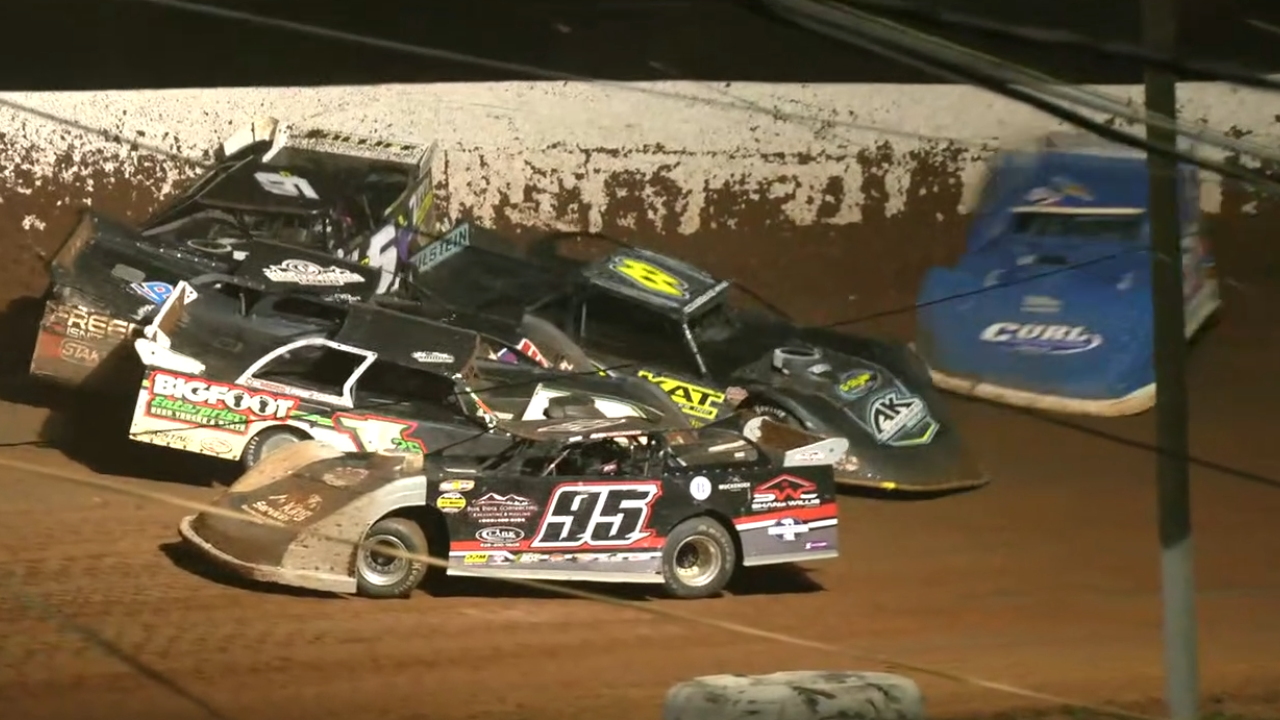
Spring Nationals Race Director Ray Cook addressed accusations of inconsistency following the tour’s race at Lake Cumberland Speedway on Saturday night.
Camaron Marlar made the accusation after he and race leader Kyle Strickler were sent to the rear after they got caught up after Alex Vance spun from contact with Mike Marlar with 32 laps left in the 53-lap feature. Vance spun in turns 3 and 4 and it snowballed collecting Kaede Loudy, Benji Hicks, and Oakley Johns. Strickler and Marlar, who was running second, had nowhere to go as they were running the top heading into three and the entire track was blocked. Both drivers spun sideways to avoid the wreck and came to a complete stop.
Marlar expressed his frustration with the call and also called for consistency in a post to Facebook, where he shared video of an incident between Benji Hicks and Michael Chilton during a heat race earlier in the night and the incident he was involved in during the feature. He wrote, “Hate being this person but Southern Nationals Series needs to get base set of rules and stick to them. First video, chain reaction, Chilton (11) gets his spot back .Second video. Tracks obviously blocked, they didn’t call caution on the radio till we are entering 3 on the cushion. Stricker and myself to the rear. Pretty similar situations, two different calls.”
Marlar also shared more details about the incident and the ruling while speaking with StockCarReport.com, “Well, the problem was the caution wasn’t thrown ’til obviously way late. The wreck had been there for a while and they didn’t throw the caution until four seconds later. That’s the issue. Their rule is fine, but obviously they don’t police it right. The heat race deal was the same situation. Honestly, a lot worse because the track wasn’t blocked and he got his spot back. Then the track’s obviously blocked and then we have to go to the tail. They just need to have a rule and stick to it, but they just don’t stick to it. That’s their problem.”
When asked if he would have had a problem being sent to the back if Chilton had also been sent to the back, Marlar said, “Correct. I would’ve been mad still. But I’ve always been a fan of if you stop you go to the tail. But now I think there’s a fine line when the track’s completely blocked and had been and they didn’t throw a caution. It was just a messy situation.”
Marlar also shared that he believed the caution was flown way too late forcing him and Strickler to have to spin, “The problem was the announcer and flagman can throw the caution, but when we’re in turn 2 we can’t see the flagman. It’s whoever’s on the Raceiver, it’s their responsibility to throw the caution and he didn’t tell us until we were entering three and then by then we can see it, but there’s nothing you can do when you’re running 80 mph against the wall. It’s a sucky deal. … If the heat race deal hadn’t have happened it would’ve been as bad. The heat race deal, it ain’t like it happened a few weeks ago or nothing. They made that call an hour and a half prior to making the next call. Just very bad.”
Cook addressed the accusation telling StockCarReport.com, “In racing, you have the choice of either making judgement calls or non-judgement calls. That’s our two choices. As an official or race director, that’s our only two choices we have. You either make judgements calls or you don’t. Neither one of those two calls are correct all the time. Neither one of them because on judgement calls you don’t always see everything and you can’t make a good judgement if you don’t see it. Non-judgement calls are not always correct either because of deals just like the other night. But the non-judgement calls has a better average of being correct and more fair to the racer at the end of the day. Sometimes it bites you the wrong way and sometimes it don’t, but if you race long enough it all works out. But neither way is correct all the time. In other words, making judgement calls is not right all the time and neither is not making judgement calls.”
Speaking specifically to the events on Saturday night at Lake Cumberland, he said, “The rule is if a car spins in front of you and you can get stopped without making contact you get your spot back. If you don’t get stopped, you go in there and hit, you are part of the wreck.”
“So in that heat race when Chilton spins … if you just look at the end of that video when they’re both parked there, there’s daylight between them. So when I look over there and I see them setting in the corner, I see daylight between the cars. I’m talking about Chilton and when he drives off, and when he comes up the front straight away, I’m looking at it and he has zero damage on the right side of his car,” Cook relayed. “So the first things I see is daylight between the cars and zero damage when he drives by. So in my mind he avoided contact and I give him his spot back.”
“Now, when I see the video, you can see that Chilton actually does go in there and make contact for just a second. But I didn’t see that. So I made my judgement on that particular deal off of what I saw. I look over there and they’re setting still and there’s daylight between them. And when he drives by me on the front straightaway there’s no damage to his car. Those are the two things I based my decision off of in that heat race,” he explained. “So I missed that one. The only way I could have caught that is if I had instant replay or had that video in front of me. But I missed that one.”
While he admitted to missing one, he did note that it didn’t affect the outcome of the race, “The only good thing about the one that we missed, you know after the fact, is that it did not affect the outcome of the race. So that’s the main thing. So just try to learn from it and do better next time.”
“The second one where they all wreck even if you don’t see that you can look over five minutes later where the wrecker’s getting them apart and see they’re all wrecked,” he noted. “And look, I hate putting them guys to the back because I know it was a bad deal. … I hated to have to put them to the back, but I can’t make judgement calls when it’s convenient, and non-judgement calls when it’s not convenient.”
When asked when he saw the replay of the Chilton incident, Cook shared, “I don’t see replays. I don’t get to see any replays until I’m on the way home and somebody sends me a video or something. I don’t have a replay in front of me.”
While that is typically how a night goes, he did share that sometimes he might have someone with the live broadcast standing next to him and he’s able to see the replay and use it to inform his calls. However, he also noted that “Flo doesn’t always get it either. You know how many times we have a lead change and announcers don’t even see it. It’s hard to get it right all the time.”
While he doesn’t typically look at replays, he does have ideas on how to make it work, but at this time it’s just not in the Spring Nationals’ budget, “The only way to do it correct is to have a camera in each corner and one on each straight away or at least an overhead drone, maybe two of them. But bottom line to do it correctly it would create some extra expense each night. If you’re going to spend a couple thousand a night to have instant replay, if you got 25 races a year, that’s $50,000. We don’t have that kind of budget. We’re so focused on trying to get the drivers so much money in points and show up money and everything we can give them that we just don’t have the extra money for an instant replay. Trust me, I’d love to have both. I’ve thought about it for years. It’s just hard.”
“That’s really the only way you could do it correctly, is just have an instant replay, have a monitor in the booth that you could rewind it, and then you’re still making a judgement, but you would have more information to make your judgement better than what we do right now.”
Additionally, Cook shared that he had explained the rulings to Marlar on Saturday night after the race, “I talked to him the other night. We actually stood up in Mikey [Marlar’s] trailer and discussed every bit of this before I left. And he gave me his opinion and I gave him mine. And we may not’ve agreed, but when I left there I thought this was over. We had already talked about it. So it wasn’t like nobody was avoiding each other.”
Finally, he addressed Marlar’s frustration about the caution coming out too late, “If you say something and it don’t go their way, they’ll say, ‘Oh, we can’t hear on it.’ But then like this, well, they said, ‘You didn’t call it quick enough.’ He ain’t listening to me half the time nowhere. You know what I mean? I don’t think that has no bearing over them wrecking.”
“Here’s the thing, when you’re calling a race, you watch the leaders. I do because the leaders are running for the most money. … The most that’s on the line for that night is happening on the leaders. So I’m watching the leaders more than I am the lap cars. So the flagman actually throwed the caution before we called it. So the lights are on, but I didn’t see it probably — they’re running 100 mph down the back straight away — many seconds before they did. But at the end of the day, they’re the ones driving the cars. So you just gotta be looking ahead.”
“I think that falls more … on the characteristics of that track. Their cars are so loose to be fast and they’re on 3-wheel brakes. When they go down in there if they don’t have plenty of time, they can’t get stopped no matter what. East Bay used to be the same way. Any track that’s circular like that like Ponderosa and Lake Cumberland both from turn 3 back to turn 2, you’re turning ’cause it’s a D-shape. The only straightaway there is the back stretch, both race tracks. So when your car’s already hanging out all the way around it’s just hard to get stopped whether you heard the Raceiver-. I can’t tell what he heard or I can’t tell when he heard. Them drivers are bound to spin things toward-. And I’ve done the same thing. Ain’t throwing off on them, but if it works in your favor you can’t hear the Raceiver, and if it does, you know what I mean. But at the end of the day when you are running that fast, with a D-shaped track like that where the cars are so loose, and you’re on 3-wheel brakes it’s hard to get stopped,” he concluded.
The Spring Nationals will be back in action on May 23rd at North Georgia Speedway and then on May 24th at Duck River Raceway Park. It concludes on May 25th at Sugar Creek Raceway. Garret Smith is the current points leader.
NEXT: Best Plumber 604 Racing Series Explains Disqualification To Cory Hedgecock
0 Comments